
Assisted living vs nursing home
Assisted living gives help with daily tasks in a home-like setting. A nursing home gives nursing care and supervision around the clock. If your parent needs a nurse on hand day and night, it's a nursing home. If they mostly need help with bathing, meals and medication, it's usually assisted living.
Assisted living also costs less. The US median is $6,200 a month, against $9,581 for a shared nursing home room, in the CareScout Cost of Care Survey 2025.
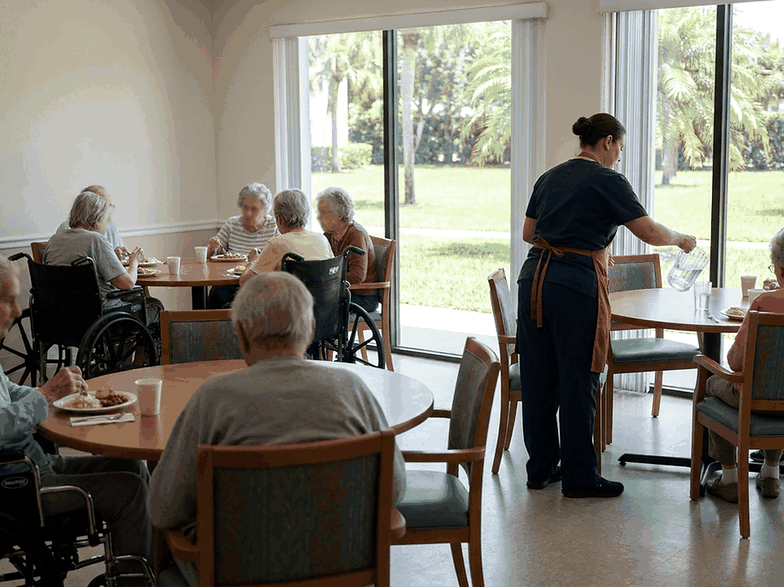
The difference in one line
Assisted living is housing with personal care; a nursing home is a health care setting with housing.
The National Institute on Aging puts it this way. Assisted living is for people who need help with daily care, but not as much help as a nursing home gives. Nursing homes, also called skilled nursing facilities, focus more on medical care.
| Assisted living | Nursing home | |
|---|---|---|
| Main purpose | Help with daily tasks | Nursing care and supervision |
| Nursing on site | A licensed nurse isn't required in Florida | 24 hours a day |
| Typical room | Own apartment or room | Private or shared room |
| US monthly median | $6,200 | $9,581 shared, $10,798 private |
| Medicare pays | No | Short skilled stays only |
| Medicaid pays | Care services through a waiver, not rent | Long-term care for people who qualify |
Who each is for
Assisted living suits someone who can't manage alone at home but is medically stable. The NIA lists what residents usually get: up to 3 meals a day, help with personal care and medication, housekeeping and laundry, 24-hour supervision and security plus social activities.
Nursing isn't a given. Florida law says an ALF isn't required to have a licensed nurse on staff, and trained aides may help with medication.
There are limits on who can live there too. In Florida, rule 59A-36.006 says a standard ALF can't admit someone who:
- Needs 24-hour nursing supervision, unless they're on hospice
- Is bedridden, unless they're on hospice
- Has a stage 3 or 4 pressure sore
- Needs tube feeding, help with an artificial airway or blood gas monitoring
- Is a danger to themselves or others
A nursing home is for people whose needs go past that line. The NIA says nursing homes typically give nursing care, 24-hour supervision, 3 meals a day and help with everyday activities. Physical, occupational and speech therapy are also on offer. Some people go in for a short skilled stay after a hospital visit. That's the part Medicare pays for.
Cost side by side
All figures are monthly medians from the CareScout Cost of Care Survey 2025.
| Where | Assisted living | Nursing home, semi-private | Nursing home, private |
|---|---|---|---|
| US | $6,200 | $9,581 | $10,798 |
| Florida | $5,610 | $10,342 | $12,167 |
| California | $7,000 | $12,167 | $15,178 |
In the US, a shared nursing home room costs $3,381 a month more than assisted living. In Florida the gap is $4,732. Texas is the one state where a shared nursing home room has a lower median than assisted living.
Assisted living prices are a base rate. Expect extra charges as care needs grow. Our cost of assisted living guide lists what usually costs extra.
What Medicare and Medicaid pay for each
Medicare. It doesn't pay for assisted living. It doesn't pay for long-term nursing home care either. Medicare.gov only pays for a skilled nursing stay of up to 100 days after a hospital stay of at least 3 inpatient days. Our Medicare guide covers the rules.
Medicaid. This is where the two differ most. For nursing homes, Medicaid can pay the whole bill for people who qualify on income and assets. In Florida that's the Institutional Care Program, run by DCF, per its SSI-Related Medicaid fact sheet. Your parent keeps a personal needs allowance of $160 a month and the rest of their income goes toward care.
For assisted living, Medicaid only pays for care services, through a home and community-based services waiver. Federal law bars those waivers from paying room and board. And only some facilities take the waiver. See our Medicaid waiver guide.
How licences and inspections differ
Assisted living is licensed by each state, under that state's rules. In Florida, the Agency for Health Care Administration (AHCA) licenses ALFs under chapter 429 of the Florida Statutes. In California, the Department of Social Services licenses them as Residential Care Facilities for the Elderly. Each state inspects to its own standards.
Nursing homes are licensed by the state too. Homes that take Medicare or Medicaid are also certified by the federal Centers for Medicare and Medicaid Services (CMS). That brings federal inspections and a national rating. CMS gives each certified home an overall rating of 1 to 5 stars. It adds separate ratings for health inspections, staffing and quality measures.
There's no national star rating for assisted living. You read the state's own inspection record instead. We show both on each facility page.
Moving from one to the other
When care needs grow, a resident may have to move from assisted living to a nursing home.
In Florida, an ALF must discharge a resident who no longer meets its continued residency rules. Some common triggers in rule 59A-36.006:
- Being bedridden for more than 7 days in a row, unless on hospice
- A stage 2 pressure sore that doesn't improve within 30 days
- Needing 24-hour nursing supervision
Florida's resident bill of rights gives your parent at least 45 days' notice before a move, except in a medical emergency. A nursing home in Florida must give 30 days' written notice before a discharge, per the Long-Term Care Ombudsman Program.
Some ALFs hold an extended congregate care licence. These can keep residents longer as they become frailer, so a move can sometimes be avoided. Ask about it before you choose.
Find both near you
You can search both types by city or ZIP on our assisted living near me finder.
- Assisted living in Florida: every licensed ALF, with 3,021 on the state roll
- Memory care in Florida: 824 ALFs that report a memory care program
- Nursing homes in Florida: 694 homes with CMS star ratings
- Assisted living in California: 8,508 licensed homes
Sources: CareScout Cost of Care Survey 2025; National Institute on Aging; Medicare.gov; CMS; Florida Statutes 429.28; Florida Administrative Code rule 59A-36.006; Florida DCF; Florida Long-Term Care Ombudsman Program.
Questions families ask
Is it cheaper to live in an assisted living or nursing home?
Assisted living is cheaper almost everywhere. The US median is $6,200 a month, against $9,581 for a shared nursing home room. Texas is the one exception in the CareScout survey.
When does someone need a nursing home instead of assisted living?
When they need nursing care or supervision around the clock, or are bedridden. Florida ALFs can't keep a resident who needs 24-hour nursing supervision, unless they're on hospice.
Does Medicare pay for either?
Not for long-term care in either one. Medicare pays for a short skilled nursing stay after a qualifying hospital stay, and for medical care wherever your parent lives.
Is a skilled nursing facility the same as a nursing home?
Mostly, yes. The NIA says nursing homes are also called skilled nursing facilities. Medicare only pays when the stay is for daily skilled care in a certified facility.
More guides for the decision
- Cost of assisted living, state by stateAssisted living costs a median $6,200 a month in the US (CareScout 2025). See every state, what the fee covers, what costs extra and the ways to pay.
- Cost of assisted living in FloridaAssisted living in Florida costs a median $5,610 a month (CareScout 2025). What it covers, nursing home and memory care costs, and the Medicaid waiver.
- Does Medicare pay for assisted living?Medicare does not pay for assisted living rent or personal care. What it does cover, the nursing home 100-day rule, and what pays instead.
- Medicaid waiver for assisted livingMedicaid waivers pay for care in assisted living, not rent. How the waivers work, who qualifies, the waitlists, and the Florida and California lists.
- How to pay for assisted living with no moneyNo savings for assisted living? How Medicaid waivers, Florida's OSS, VA Aid and Attendance and a nursing home on Medicaid work, and where to ask first.
- Florida assisted living regulationsFlorida ALF rules in plain words: the licence types, staff training, help with medication, discharge notice, resident rights and how to complain.
Or search assisted living near you.